Super-fine membrane fibres
Compared to conventional membrane fibre dryers, the fibres in the Kaeser membrane module are significantly finer and more numerous, thereby increasing their surface area. In turn, this delivers superior drying performance compared to conventional designs. This is augmented yet further due to the high mechanical stability of the membrane fibres.
Flow concept
The hollow membrane fibres consist of a highly porous support layer and an internal, water-permeable separation layer. The pressure differential between the moist compressed air outside the fibre and the almost atmospheric flow of purge air through the centre encourages water molecules to permeate through the fibre wall. The pores of the support layer therefore always remain permeable.
Efficient drying
The spiral helical structure of the fibres in the inner chamber of the dryer module means that the module is now shorter, yet has the same drying capacity as previous, longer models – whilst nevertheless boasting a greater active membrane surface area per unit of volume. The helical fibre structure also promotes even distribution of air around the fibres and encourages the movement of water molecules.
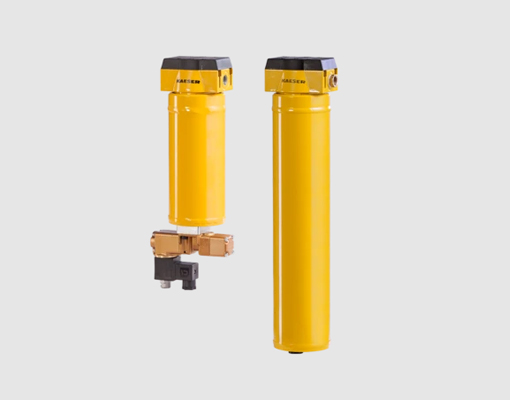
KMM with purge air stop valve for even greater energy savings
* KMM membrane module with flow concept and helical fibre structure
* Solenoid pilot-valve: 230 V, 50 Hz, 240 V, 60 Hz, open when de-energised
* Configured and pre-assembled for immediate use.
* Outlet silencer also included
 |
* Compressed air inlet
* Membrane fibre module
* External casing
* Purge air nozzle
* Purge air outlet
* Compressed air outlet |
Moist compressed air flows into the module casing, where it comes into contact with the membrane fibres. A minimal amount of this now dry compressed air is used as purge air and is drawn upwards around the fibres and expands to atmospheric pressure. The resulting increase in volume increases the air’s water retention capacity. In combination with with the selectivity of the membrane, the differing water content of the purge air flow and the flow of air to be dried (both flowing in opposite directions), allows water molecules – almost exclusively – to diffuse through the fibre wall. There are separate outlets for the dried compressed air and the purge air.